
What Is a Cashmere Sweater?
A cashmere sweater is a premium knitwear garment made from the ultra-fine undercoat fibers of cashmere goats, primarily sourced from Mongolia, China, and the Himalayan region. It is prized for its exceptional softness, lightweight warmth, and breathability, making it one of the most sought-after natural fiber garments in luxury fashion.
What You Need to Know About Cashmere Sweaters
Cashmere sweaters sit at the pinnacle of luxury knitwear because the fiber they are made from is extraordinarily rare and labor-intensive to produce. A single cashmere goat yields only about 150 to 200 grams of usable fiber per year, and it takes the fleece of three to five goats to produce enough material for one sweater. The resulting fabric is seven to eight times warmer than regular sheep wool, yet dramatically lighter and softer against the skin. Whether you are buying your first cashmere sweater or looking to deepen your understanding of this premium material, this guide covers everything from fiber origins to care instructions.
What Is Cashmere Made From?
Cashmere is made from the fine undercoat of the Capra hircus goat, a breed commonly known as the cashmere goat. These animals thrive in the extreme temperature climates of Inner Mongolia, the Gobi Desert, Afghanistan, Iran, and the high plateaus of Tibet and Nepal. To survive bitterly cold winters that drop well below freezing, these goats develop a dense, insulating undercoat beneath their coarser outer coat of guard hair. It is this delicate undercoat, with individual fibers measuring between 14 and 19 microns in diameter, that constitutes true cashmere.
The fiber diameter is what separates cashmere from ordinary wool. Standard sheep wool typically ranges from 20 to 30 microns, while the finest cashmere sits closer to 14 to 16 microns. A human hair measures roughly 70 microns for reference. This fineness is the primary reason cashmere feels so extraordinarily soft against the skin, and why it does not cause the itching or irritation associated with coarser natural fibers.
The region in which a goat lives directly affects fiber quality. The harsh temperature swings of Inner Mongolia, which can range from minus 40 degrees Celsius in winter to over 40 degrees in summer, produce particularly fine and dense undercoats. This harsh climate is considered the ideal condition for developing the highest-quality cashmere fibers in the world.
How Is Cashmere Made? From Goat to Garment
Understanding how cashmere is made adds considerable context to its price tag and value. The production process is long, seasonal, and dependent almost entirely on skilled hand labor at multiple stages.
Combing and Collection
Cashmere is harvested once a year during spring, when the goats naturally shed their winter undercoat. Farmers comb the animals by hand using a wide-toothed tool designed to separate the soft undercoat from the coarser guard hairs without damaging either. This process takes considerable time and patience per animal, and because each goat yields so little usable fiber, the collection phase alone is resource-intensive before any manufacturing begins.
De-hairing and Sorting
Once collected, the raw fleece goes through a de-hairing process in which the coarse guard hairs are mechanically or manually removed from the fine undercoat. This step is critical because any residual coarse fiber in the final product will compromise softness and quality. After de-hairing, the fiber is sorted by fineness, color, and length, with the finest and longest fibers reserved for premium garments.
Spinning and Dyeing
The cleaned and sorted fibers are then spun into yarn. Depending on the intended ply and thickness of the final garment, the yarn may be spun tightly for durability or loosely for extra softness. Dyeing follows spinning in most production processes, using either natural or synthetic dyes. High-end producers tend to dye the fiber before spinning to achieve better color penetration and consistency.
Knitting and Finishing
The yarn is then knitted, either by hand or on specialized machines, into the final sweater construction. Finishing steps include washing, blocking, and in some cases, brushing the surface to raise a fine nap that enhances softness. These finishing touches are what give a well-made cashmere sweater its characteristic cloud-like feel.
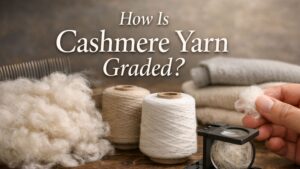
(See our guide on how cashmere yarn is graded for more detail on quality tiers.)
Why Is Cashmere So Expensive?
The high price of a cashmere sweater is not a marketing illusion. It reflects genuine scarcity, labor intensity, and the physical limitations of the fiber’s natural source.
The most fundamental factor is yield. A single cashmere goat produces roughly 150 to 200 grams of usable fiber annually, whereas a merino sheep can yield several kilograms. Building one sweater requires fiber from multiple goats, and that fiber must be hand-combed, sorted, de-haired, and spun before any knitting begins. The entire supply chain is slow and seasonal by nature.
Geographic concentration is another major driver of cost. The vast majority of the world’s premium cashmere originates in Mongolia and Inner China. Fluctuations in weather, pasture quality, and regional economics can significantly affect annual output, creating supply unpredictability that supports higher prices.
Labor costs compound the issue further. Skilled artisans in Scotland, Italy, and Japan who hand-finish or hand-knit cashmere garments represent decades of craft tradition. Their labor is factored into garment pricing, particularly for heritage brands operating in high-cost production markets.
Finally, cashmere has become a status signal within high-end fashion. Brands including Loro Piana, Brunello Cucinelli, and Johnstons of Elgin have built entire positioning strategies around cashmere quality, creating aspirational demand that supports premium pricing at both the high end and in the mass-accessible middle tier of the market.
Cashmere vs Wool: What Is the Difference?
Cashmere and wool are both natural fiber textiles derived from animals, but they differ substantially in texture, warmth-to-weight ratio, durability, and cost. The table below summarizes the key differences.
| Feature | Cashmere | Merino Wool |
|---|---|---|
| Source Animal | Cashmere goat | Merino sheep |
| Fiber Diameter | 14 to 19 microns | 17 to 24 microns |
| Warmth-to-Weight | Significantly higher | Moderate |
| Softness | Exceptionally soft | Soft, may vary |
| Durability | Lower, requires care | Higher, more resilient |
| Breathability | High | High |
| Moisture Wicking | Moderate | Excellent |
| Price | Premium to luxury | Moderate to premium |
| Best Use | Elevated everyday wear, dress occasions | Active use, outdoor wear |
| Pilling Risk | Higher with low-grade cashmere | Lower |
The most important distinction is that cashmere is not simply “better” than wool in every context. Merino wool is more durable, more moisture-wicking, and more suitable for active or outdoor use. Cashmere, however, outperforms wool in softness, warmth per gram, and perceived luxury. For a winter wardrobe essential meant for daily wear or polished occasions, cashmere offers an experience that wool simply cannot replicate.
Benefits of a Cashmere Sweater
The benefits of cashmere fabric extend well beyond its softness. Understanding what this fiber actually offers helps justify the investment.
Exceptional thermal insulation is the first and most practical benefit. Cashmere fibers trap air within their fine structure, creating a layer of insulation that keeps body heat close to the skin even in very cold conditions. This thermal efficiency per unit of weight is far superior to most other natural fibers.
Breathability makes cashmere suitable across a broader temperature range than many assume. Because the fine fibers allow air circulation, a cashmere sweater does not cause overheating the way a heavy synthetic or dense wool garment might. This breathable fabric quality makes cashmere an excellent transitional season piece as well as a core winter garment.
Hypoallergenic properties are a significant benefit for people with skin sensitivities. The fine fiber diameter of cashmere means the tips of individual fibers do not prick the skin the way coarser wool fibers can. Many people who find standard wool irritating wear cashmere without discomfort.
Longevity with proper care is another compelling benefit. A high-quality cashmere sweater, cared for correctly, can last 10 to 20 years and improve in softness over time. The investment cost per wear over a garment’s lifespan often makes cashmere comparable to or more economical than lower-quality alternatives replaced every one to two seasons.
Versatility within a wardrobe rounds out the case. A well-chosen cashmere sweater moves from casual weekend wear to business settings and even semi-formal occasions depending on styling. Its neutral, refined aesthetic integrates easily across wardrobe contexts.
Types of Cashmere Sweaters
Not all cashmere sweaters are constructed or graded equally. Understanding the main types helps buyers make informed decisions.
By Ply
Ply refers to the number of cashmere yarn strands twisted together to form the knitting yarn. A 1-ply cashmere sweater uses a single strand and is lighter and more delicate. A 2-ply sweater, the most common standard for quality garments, uses two twisted strands and offers a better balance of softness and durability. 3-ply and 4-ply constructions produce heavier, thicker sweaters suitable for extreme cold.
By Knit Structure
Crew neck sweaters are the most versatile and widely produced style. V-neck cashmere sweaters layer easily over shirts and are common in business or smart casual contexts. Turtleneck and roll-neck cashmere designs provide maximum neck coverage. Cardigan styles in cashmere offer a relaxed, layerable option. Cable-knit cashmere is a textured construction that adds visual depth while increasing warmth.
By Grade
Cashmere quality is graded primarily by fiber fineness and length. Grade A cashmere, the highest tier, uses the finest and longest fibers and is found in premium garments. Grade B uses slightly coarser, shorter fibers and is common in mid-range products. Grade C, the lowest commercial tier, may feel noticeably rougher and will not have the longevity of higher grades.
By Origin of Fiber
Scottish cashmere, produced from Mongolian fiber processed and knitted in mills in Scotland, is considered a gold standard. Italian cashmere, particularly from mills in the Biella region, is similarly prestigious. Chinese-manufactured cashmere spans a wide quality range from excellent to poor depending on the producer.
How to Identify Real Cashmere
Pure cashmere meaning is a garment made from 100 percent cashmere fiber with no blending. The following tests and checks help verify authenticity before purchase.
The burn test is a reliable at-home method. Cashmere, like all protein-based fibers, burns slowly, smells like burning hair, and leaves a crushable ash. Synthetic fibers melt, smell chemical, and leave hard plastic residue.
The rub test gives a quick tactile indication. Rub the fabric briskly against itself for 10 seconds. Low-quality or blended cashmere will begin to pill immediately. High-quality pure cashmere will pill slightly over time with wear but should show minimal immediate pilling from light friction.
Check the label carefully. A genuine pure cashmere sweater will be labeled “100% cashmere.” Labels reading “cashmere blend,” “pashmina,” or simply “luxury wool” do not guarantee pure cashmere content.
Price is not a foolproof indicator on its own, but it is a practical guide. A genuine, pure cashmere sweater in current retail markets should cost a minimum of 100 to 150 USD at the lower end of the quality range. Garments marketed as cashmere for 20 to 40 USD are almost certainly blended, mislabeled, or made from very short, coarse cashmere fibers that will not hold up.
Common Myths About Cashmere
Several persistent myths surround cashmere fabric that are worth addressing directly.
Myth: Cashmere always pills excessively. Pilling is primarily a sign of shorter, lower-grade fibers. High-quality cashmere from long, fine fibers pills minimally with proper care. Excessive pilling is a quality problem, not an inherent property of cashmere itself.
Myth: Dry cleaning is the only safe option. Most quality cashmere sweaters can be hand-washed in cold water with a gentle detergent designed for delicate fabrics. (See our guide on washing cashmere sweaters.) Dry cleaning is an option but not a requirement.
Myth: Cashmere and pashmina are the same thing. Pashmina is a Nepali and Kashmiri term for cashmere fiber, traditionally referring to the very finest hand-spun and hand-woven cashmere from the Changthangi goat of the Himalayan highlands. In modern retail, “pashmina” is frequently misused as a marketing term on blended or synthetic shawls with no cashmere content. The terms are not interchangeable.
Myth: All cashmere feels equally soft. Fiber diameter, fiber length, processing method, and finishing all affect final softness substantially. Two garments both labeled 100 percent cashmere can feel notably different because of these variables.
Myth: Thicker means warmer. A lightweight, well-structured 2-ply cashmere sweater will often outperform a thick, loosely constructed garment in thermal insulation because fiber alignment and knit density matter as much as thickness.
Cashmere Sweater Buying Guide
Buying your first quality cashmere sweater is a decision worth making deliberately. The following considerations will help you choose well.
Start with fiber grade and origin. Look for Grade A cashmere sourced from Inner Mongolia, and produced by a mill with a trackable supply chain. Brands that offer transparency about fiber sourcing tend to produce more consistent quality.
Consider ply relative to intended use. For a lightweight layering piece or warmer climates, 1-ply or fine 2-ply is appropriate. For a primary cold-weather sweater worn in genuinely low temperatures, a heavier 2-ply or 3-ply construction will perform better.
Evaluate construction by examining seams and edges. Fully fashioned knitwear, where each panel is knit to shape before assembly, produces more durable and better-fitting sweaters than cut-and-sew construction in which knitted fabric is cut to shape and seamed. Fully fashioned seams will appear neat and structured; cut-and-sew seams often have a rougher, bulkier finish.
Choose a neutral or versatile color for a first purchase. Camel, ivory, grey, and navy translate across the widest range of styling contexts and show the natural quality of the fiber well. Heavily dyed cashmere in bright or novelty colors may use dyeing processes that compromise fiber integrity over time.
Set a realistic budget. In 2024 to 2025 retail, a genuinely good-quality 100 percent cashmere sweater from a credible brand starts around 150 to 250 USD. Landmark heritage brands such as Johnstons of Elgin, N.Peal, or Loro Piana command significantly higher prices but offer exceptional fiber quality and long-term durability.
How to Care for a Cashmere Sweater
Proper care extends the life of a cashmere sweater significantly. The core rules are straightforward.
Hand wash in cool water using a gentle, pH-neutral detergent or a product formulated specifically for wool and cashmere. Submerge the sweater, gently squeeze water through the fabric, and avoid any wringing or twisting that can stretch or distort the fibers.
Rinse thoroughly, then remove excess water by pressing the garment gently against the side of the sink. Do not wring. Lay the sweater flat on a clean dry towel, reshape it to its original dimensions, and allow it to dry naturally away from direct heat or sunlight.
Store cashmere folded, never hung. Hanging stretches the shoulders and distorts the shape over time. For long-term storage, fold and place in a breathable cotton bag with cedar blocks or lavender sachets to deter moths, which are attracted to natural protein fibers.
Invest in a cashmere comb or fabric shaver for managing pilling. Even high-quality cashmere can develop light surface pills in high-friction areas such as under the arms over repeated wear. A fabric shaver removes these quickly and restores the surface appearance of the garment.
(See our guide on washing cashmere sweaters for step-by-step instructions)
Conclusion
A cashmere sweater is more than a cold-weather garment. It represents one of the most refined expressions of what natural fiber clothing can be, combining superior thermal insulation, breathable fabric comfort, and enduring softness into a single piece that, with proper care, can outlast decades of trend cycles. Understanding what cashmere is made from, how it is produced, and what separates genuine quality from imitation gives you the knowledge to invest wisely, wear confidently, and care properly for a garment that genuinely earns its reputation as a winter wardrobe essential.
Frequently Asked Questions
What is a cashmere sweater?
A cashmere sweater is a knitted garment made from the fine undercoat fibers of cashmere goats, primarily raised in Mongolia and China. It is valued for exceptional softness, lightweight warmth, and breathability. Cashmere fiber is finer than sheep wool, making it one of the most luxurious natural textiles available.
What is cashmere made from?
Cashmere is made from the soft undercoat of the cashmere goat, a breed native to cold-climate regions including Mongolia, Afghanistan, and the Himalayas. The undercoat fibers measure 14 to 19 microns in diameter, significantly finer than standard sheep wool, which is what gives cashmere its distinctive softness.
Is cashmere warmer than wool?
Yes, cashmere is typically warmer than regular wool because its fibers are finer and trap heat more efficiently. High-quality cashmere provides excellent thermal insulation while remaining lightweight and breathable, making it ideal for cold weather layering without bulk.
Why is cashmere so expensive?
Cashmere is expensive because each goat produces only 150 to 200 grams of usable fiber per year, requiring multiple animals per sweater. The fiber must be hand-combed, de-haired, sorted, and spun before knitting. This combination of scarcity, seasonal harvesting, and skilled labor drives the premium price.
What does pure cashmere mean?
Pure cashmere means the garment contains 100 percent cashmere fiber with no blended wool, synthetic fiber, or other materials mixed in. On a label, look for “100% cashmere.” Blended products may be labeled “cashmere blend” and will contain a lower percentage of actual cashmere alongside cheaper fibers.
How do I know if my cashmere sweater is real?
Check the label for “100% cashmere,” perform a burn test where genuine cashmere smells like burning hair and leaves a crushable ash, and assess the price. Authentic cashmere sweaters rarely retail below 100 to 150 USD. Very cheap products labeled as cashmere are almost certainly blends or mislabeled.
How long does a cashmere sweater last?
A high-quality cashmere sweater can last 10 to 20 years or more with proper care. The key factors are fiber grade, construction quality, and maintenance routine. Lower-grade cashmere with shorter fibers will deteriorate faster. Washing correctly, storing folded, and using a fabric shaver extends garment life considerably.
How should I wash a cashmere sweater?
Hand wash cashmere in cool water with a gentle, pH-neutral detergent. Submerge and gently squeeze without wringing. Rinse thoroughly, press water out against the sink, then lay flat on a dry towel to air dry. Avoid machine washing, tumble drying, and direct heat, all of which can shrink or damage the fibers.
Does cashmere shrink?
Yes, cashmere can shrink if exposed to hot water, high heat from a dryer, or aggressive agitation. The protein fibers contract and felt when subjected to heat and friction. Always wash in cool to cold water and dry flat at room temperature to prevent shrinkage and fiber damage.
What is the difference between cashmere and pashmina?
Pashmina traditionally refers to the very finest hand-spun cashmere from the Changthangi goat of the Himalayas, and is a regional term for high-grade cashmere. In modern retail, “pashmina” is frequently applied to blended or synthetic shawls that contain little to no real cashmere. Genuine pashmina is a type of cashmere, not a separate fiber.
Is cashmere suitable for people with wool allergies?
Many people who experience irritation from standard wool can wear cashmere comfortably because its fiber diameter is much finer and the tips do not prick the skin. However, a true wool allergy is a protein-based immune response, and since cashmere is also a protein fiber, those with documented wool allergies should test with caution before committing to a purchase.
What ply cashmere is best?
For most buyers, a 2-ply cashmere sweater offers the best combination of softness, warmth, and durability. 1-ply is ideal for lightweight layering in milder conditions. 3-ply and 4-ply constructions are better suited to very cold climates where maximum thermal insulation is the priority. Ply alone does not determine quality; fiber grade matters equally.